
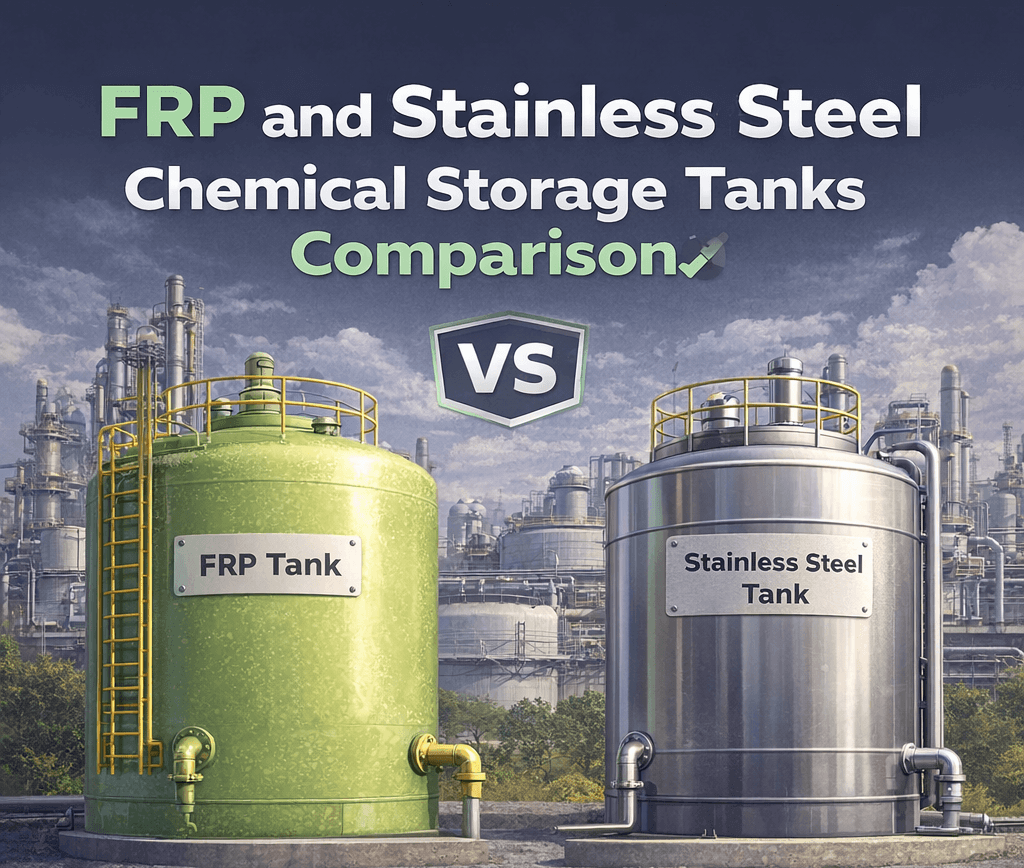
FRP vs. Stainless Steel Tanks for Chemical Storage: Which One Is Better?
Technical comparison between FRP and stainless steel tanks for industrial chemical storage. Corrosion resistance, lifecycle cost, and applicable ASTM standards.
FRP vs. Stainless Steel Tanks for Chemical Storage: Which One Is Better?
In chemical processing and industrial manufacturing, selecting the right material for corrosive media storage is a critical decision that directly impacts operational safety and Total Cost of Ownership (TCO). While stainless steel has historically been the industry standard, Fiber Reinforced Plastic (FRP) tanks have proven to be a superior alternative in demanding chemical applications.
Corrosion Resistance: The FRP Advantage
Stainless steel relies on a passive chromium oxide layer to resist corrosion. When this layer is compromised by aggressive chemicals such as hydrochloric acid or high-chloride solutions, the metal suffers from pitting or stress-corrosion cracking. In contrast, FRP tanks engineered with vinyl ester and bisphenolic resin systems are inert to a much wider pH range, providing total chemical resistance throughout the laminate without the need for secondary coatings that may delaminate over time.
- Chemical resistance validated per ASTM C581 for the specific resin system of each application
- No risk of pitting or stress-corrosion cracking
- Resin system selection tailored to the specific chemical, concentration, and service temperature
- Internal chemical barrier without secondary coatings that may delaminate over time
Comparative Analysis: Performance and Cost
When evaluating both materials, it is essential to consider not only the purchase price but the Total Cost of Ownership (TCO):
- Strength-to-weight ratio: FRP offers mechanical strength comparable to steel while being up to 75% lighter, simplifying logistics and installation on elevated platforms without expensive structural reinforcement
- Thermal and electrical conductivity: FRP is a natural insulator, reducing heat loss and eliminating the risk of galvanic corrosion in interconnected metallic tank systems
- Technical customization: Unlike steel, FRP allows for variations in resin formulation and fiber orientation specifically tailored to the stored chemical
- Maintenance: Properly specified FRP tanks require minimal maintenance — primarily visual inspections of the internal chemical barrier
Applicable Standards
The design, fabrication, and inspection of FRP tanks for chemical service are governed by internationally recognized ASTM standards:
- ASTM D3299 — filament-wound glass-fiber-reinforced thermoset resin chemical-resistant tanks
- ASTM D4097 — contact-molded glass-fiber-reinforced thermoset resin chemical-resistant tanks
- ASTM C581 — chemical resistance evaluation of thermosetting resin laminates intended for liquid service
Life Cycle and Sustainability
An improperly specified stainless steel tank can require replacement or major repairs in less than 10 years in highly saline or acidic environments. An FRP tank designed to ASTM D3299 or ASTM D4097 can exceed 25 years of service life with minimal preventive maintenance, representing a significantly lower lifecycle cost in aggressive chemical storage applications.
Our Experience
With over 40 years of exclusive FRP manufacturing experience, Plastimarmol has supplied chemical storage tanks to large-scale mining, chemical, and industrial operations across Mexico, the United States, and internationally. Across more than 2,600 completed projects, every tank is custom-engineered to ASTM standards and built specifically for the chemical, concentration, and operating conditions of each application.
Final Thoughts
For most industrial chemical storage applications, FRP tanks offer better corrosion resistance, lower long-term maintenance, and greater design flexibility than stainless steel. Material selection should always be based on actual service conditions and validated engineering standards.
References
ASTM International. (2022). ASTM D3299: Standard specification for filament-wound glass-fiber-reinforced thermoset resin chemical-resistant tanks. ASTM International. https://www.astm.org/d3299-22.html
ASTM International. (2021). ASTM D4097: Standard specification for contact-molded glass-fiber-reinforced thermoset resin chemical-resistant tanks. ASTM International. https://www.astm.org/d4097-21.html
ASTM International. (2019). ASTM C581: Standard practice for determining chemical resistance of thermosetting resins used in glass-fiber-reinforced structures intended for liquid service. ASTM International. https://www.astm.org/c0581-03r19.html