
FRP Gratings vs Galvanized Steel: Which Lasts Longer?
A manufacturer's technical comparison of FRP and galvanized steel gratings for corrosive environments — corrosion resistance, weight, maintenance, and what we build to.
FRP Gratings vs Galvanized Steel: Which Lasts Longer?
When specifying gratings, platforms, or walkways for a corrosive plant environment — mining circuits, wastewater treatment, chemical processing — the material choice determines how many times you'll replace the installation before the equipment around it reaches end of life. Galvanized steel has been the default for decades because it's familiar and inexpensive up front. But in the presence of acids, chlorides, hydrogen sulfide, or continuous moisture, the zinc coating that protects galvanized steel has a finite service life, and once it's breached, the base steel corrodes underneath it. Fiberglass reinforced plastic (FRP) gratings were developed specifically to eliminate that failure mode. This guide compares how each material performs in corrosive service, what drives total cost over the life of the installation, and what we build to when manufacturing FRP gratings.
Why the Material Choice for Gratings Matters
Gratings and walkways aren't cosmetic components — they're structural surfaces that plant personnel walk and work on every day, often directly above tanks, sumps, or process equipment. When a grating panel corrodes, the failure isn't just aesthetic; it becomes a safety and structural integrity issue. In mining and chemical facilities, gratings are frequently installed in the most aggressive zones of the plant: above leaching tanks, around scrubbers, over trenches carrying process effluent. Replacing corroded panels means production downtime, scaffolding, and confined-space work. Getting the material decision right at the design stage avoids a recurring maintenance liability.
How Galvanized Steel Fails in Corrosive Environments
Galvanizing works by sacrificing a zinc coating to protect the base carbon steel underneath. That zinc layer corrodes preferentially, which is effective — until it's consumed. In continuous exposure to acids, chlorides, or hydrogen sulfide (common in wastewater treatment atmospheres), the zinc layer degrades faster than in a benign environment, and once it's breached, the exposed steel rusts directly. This process is progressive and often invisible from the top surface until panels are pulled for inspection. Steel gratings installed near dissimilar metals, stray electrical currents, or electrolytic process equipment — such as electrowinning cells — also carry a galvanic corrosion risk, since steel is an active participant in that electrochemical pathway.
Why FRP Gratings Resist What Steel Can't
FRP gratings are non-metallic, so there is no oxidation or rust mechanism at all. Corrosion resistance comes from the resin matrix itself — typically an isophthalic or a corrosion-grade vinyl ester resin selected for the specific chemical exposure — not from a thin surface coating that can be breached. That means degradation, if it occurs, is slow and uniform through the laminate rather than a sudden coating failure followed by rapid base-material corrosion.
- FRP is electrically non-conductive, which removes it from the galvanic corrosion pathway entirely — a real advantage near electrowinning cells, control rooms, or any area with stray current risk.
- UV-stabilized resin formulations extend service life for gratings exposed to direct sunlight, standard for outdoor platforms and walkways.
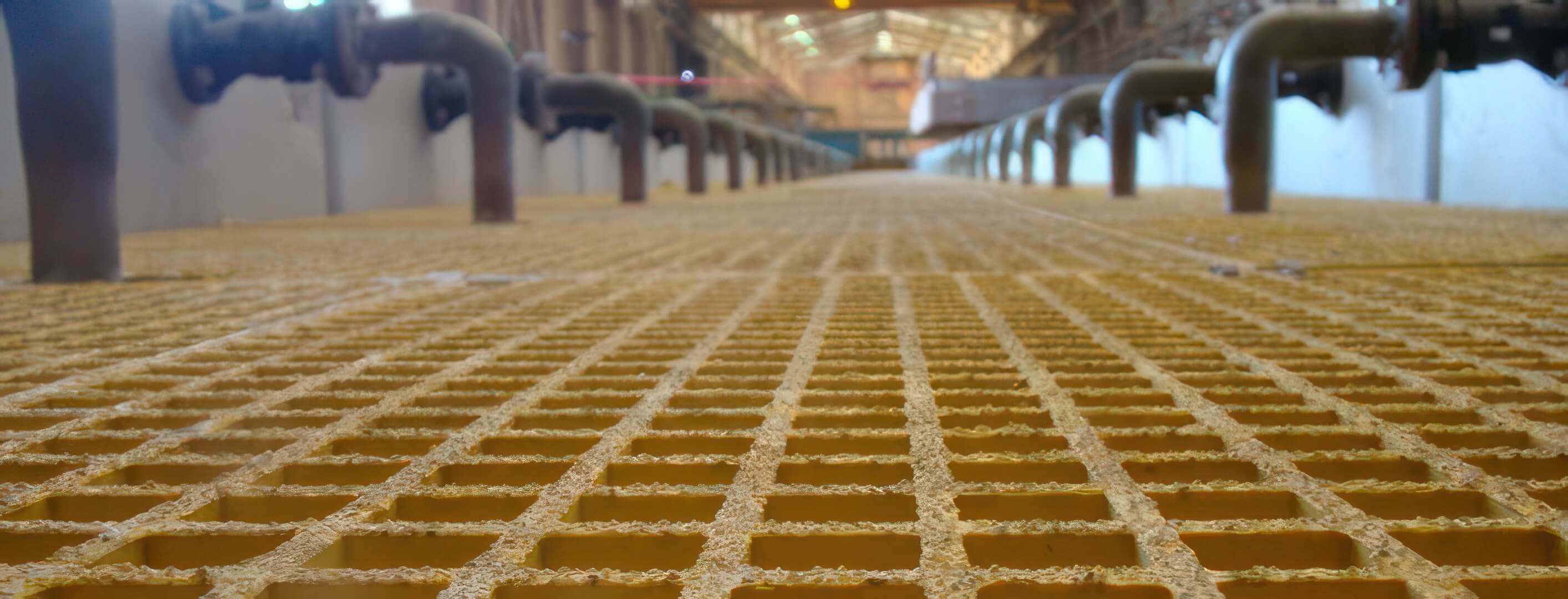
- Surface finish (grit-top, covered mesh, or a molded concave-grit pattern) provides slip resistance built into the laminate rather than applied as a coating that wears off over time.
- FRP doesn't require repainting, recoating, or cathodic protection to maintain its corrosion resistance over its service life.
Weight, Installation, and Long-Term Cost Considerations
FRP gratings weigh a fraction of steel gratings of comparable size and load class, which simplifies handling and installation — often without cranes or heavy rigging, especially valuable for retrofits, remote sites, and elevated platforms. Lower weight also reduces the load on supporting steelwork, which matters when retrofitting gratings onto existing structures not originally designed for heavier steel panels. Over the life of the plant, the absence of a recurring recoating or replacement cycle is what typically separates the total cost of ownership between the two materials — not the upfront panel price alone.
What We Specify When Manufacturing FRP Gratings
- Mesh or grid pattern and opening size, matched to pedestrian, forklift, or equipment traffic.
- Panel thickness and load rating for the expected foot and vehicle traffic in that specific area of the plant.
- Resin system matched to the chemical exposure — general-purpose isophthalic versus a corrosion-grade vinyl ester for aggressive acid or solvent service.
- Surface finish: grit-top, covered mesh, or molded concave-grit for slip resistance in wet or oily areas.
- UV-stabilized pigment and resin for gratings exposed to continuous outdoor sunlight.
- Flame-retardant resin formulation where local code or plant safety requirements call for it.
- Fastening clips and hardware compatible with the adjacent structure, to avoid introducing a new galvanic pathway.
- Panel dimensions and cut-outs required for equipment penetrations, pipe runs, or access hatches.
Applicable ASTM Standards
The resin system used in an FRP grating laminate can be evaluated against the specific process chemistry using ASTM C581, which determines the chemical resistance of thermosetting resins in glass-fiber-reinforced structures intended for liquid or corrosive service. ASTM D543 provides a broader practice for evaluating how the finished plastic resists specific chemical reagents, useful when comparing resin options against the exact acids, bases, or solvents present in a given process area. For gratings destined for aggressive acid exposure — around leaching or scrubbing operations, for example — ASTM D2583 (Barcol hardness) is a practical quality-control check we run to confirm the resin matrix has fully cured before panels leave the shop.
Our Experience
In more than 40 years fabricating exclusively FRP products, across 2,600+ completed projects, we at Plastimarmol have supplied gratings, platforms, and structural components into mining, chemical, and water treatment facilities where galvanized steel had already failed once and needed to be replaced. The pattern is consistent: gratings installed in acid mist, chloride spray, or hydrogen sulfide atmospheres are where the difference between the two materials shows up fastest.
Final Thoughts
Galvanized steel gratings can work fine in benign, dry environments. But in mining, chemical processing, or wastewater treatment — anywhere acids, chlorides, hydrogen sulfide, or continuous moisture are present — the zinc coating that protects steel has a finite life, and FRP was designed to eliminate that failure mode entirely. If you're specifying gratings, platforms, or walkways for a corrosive area of your plant, tell us your traffic loads, chemical exposure, and dimensions, and we'll help you define the right resin system and panel design. Request a quote from Plastimarmol.
References
ASTM International. (2020). Standard practice for determining chemical resistance of thermosetting resins used in glass-fiber-reinforced structures intended for liquid service (ASTM C581-20). ASTM International.
ASTM International. (2021). Standard practices for evaluating the resistance of plastics to chemical reagents (ASTM D543-21). ASTM International.
ASTM International. (2025). Standard test method for indentation hardness of rigid plastics by means of a Barcol impressor (ASTM D2583-25). ASTM International.